Your
Platform
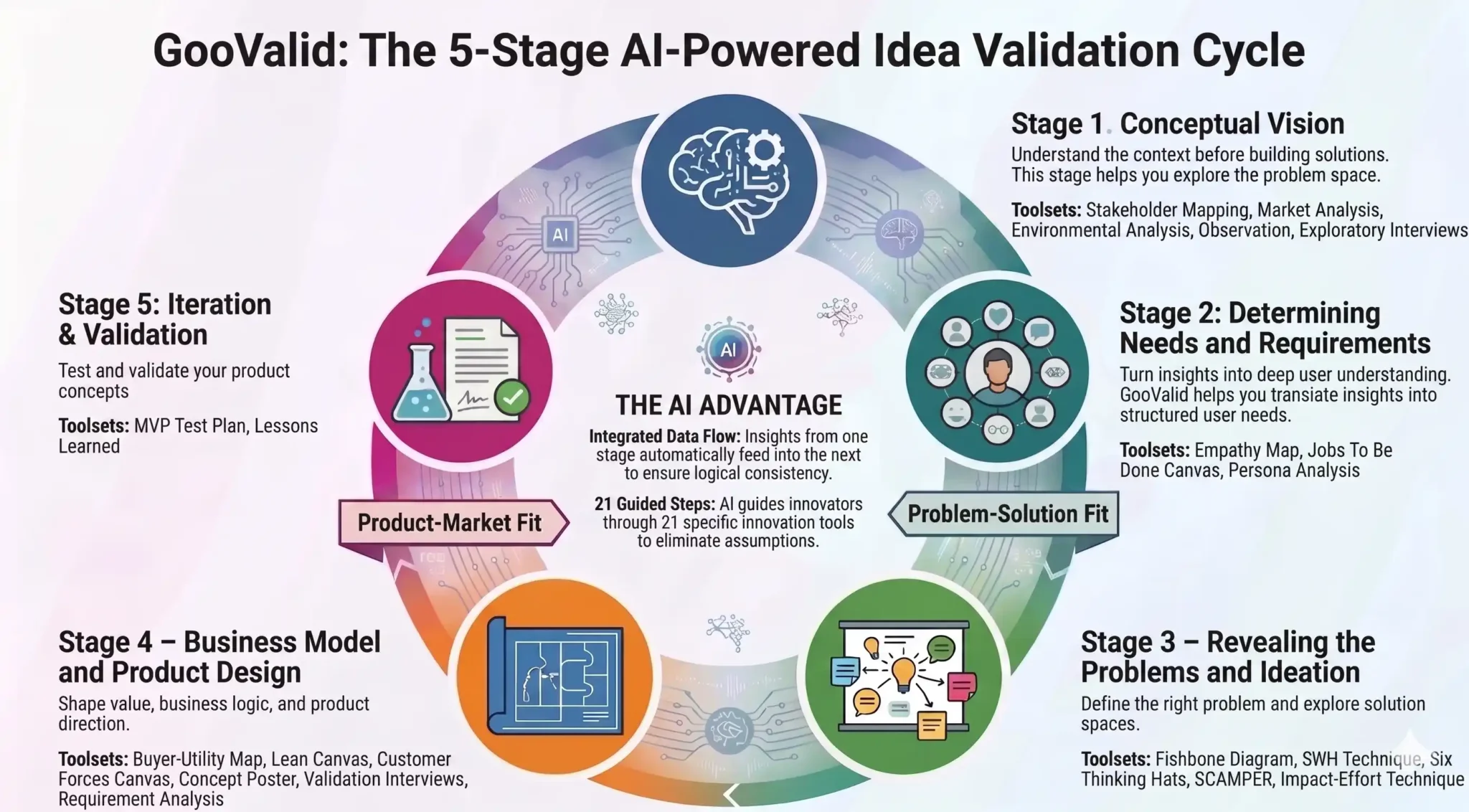
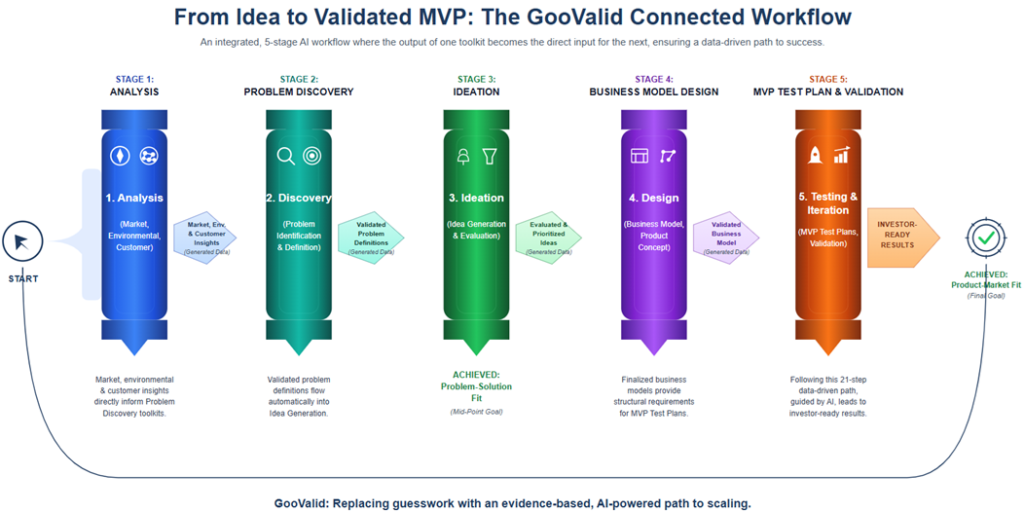
GooValid is an AI-powered business idea validation platform that helps entrepreneurs, R&D teams, and corporate innovators systematically test and refine their ideas before investing significant resources into development. It integrates proven frameworks such as Design Thinking, Lean Startup, and Business Model methodologies into a single, structured validation workflow.
We are an AI-powered platform that helps project teams, startups and corporate innovators achieve problem-solution fit and product-market fit faster and smarter.

Know Before
You Build.
Underscore early-stage validation before costly execution.

Validate What Matters - Faster.
Focus on speed and prioritization of real needs.

From Assumption to Action. Instantly.
Bridge the gap between idea and insight with AI speed.

Accelerate Fit. Reduce Risks.
Highlight both problem-solution and product-market fit validation.
Startup
$28.90
Corporate
$269
Custom
Launching a startup without validating the idea is one of the most common reasons new ventures fail. Many founders invest months—or even years—developing products that the market simply doesn’t need. Business idea validation is the structured process of testing whether your concept solves a real problem and whether people are willing to pay for it.
In this guide, you will learn what business idea validation is, why it matters, and how modern tools and structured frameworks can help entrepreneurs verify ideas faster and more accurately.
Business idea validation is the process of confirming that a business concept has real market demand before significant time or money is invested in building it.
Instead of relying on intuition or assumptions, validation uses data, feedback, and testing methods to answer critical questions:
Does this problem truly exist?
Are people actively searching for a solution?
Are potential customers willing to pay for it?
Is the market large enough to support the business?
By validating ideas early, founders dramatically reduce the risk of building products that fail after launch.
According to startup research, one of the leading causes of failure is lack of product-market fit. Entrepreneurs often fall in love with their ideas but overlook whether the market actually needs them.
Validating an idea before building a product provides several advantages:
Developing software, hardware, or services requires investment. Validation allows founders to test ideas before committing large budgets.
Successful businesses solve clear and urgent problems. Validation helps determine whether the pain point is significant enough for customers to seek a solution.
Feedback gathered during validation can shape the product direction, features, and positioning.
Investors prefer startups that already demonstrate demand. Validation metrics such as signups, surveys, or waitlists help prove market interest.
Not every idea is ready to launch immediately. Here are some indicators that validation is necessary:
The idea is based on assumptions rather than research
You are unsure who the target customer is
There are no existing competitors or alternatives
You do not know if customers will pay for the solution
In these cases, validation becomes essential to avoid costly mistakes.
Validating a business idea is not a single action—it is a structured process. The following framework is widely used by entrepreneurs, accelerators, and startup advisors.
Every successful business starts with a problem worth solving. Begin by identifying:
The specific problem
Who experiences it
How frequently it occurs
Why current solutions are insufficient
A clearly defined problem helps ensure that your business addresses a real need.
Validation requires input from the right people. Determine:
Customer demographics
Industry or niche
Behavioral characteristics
Purchasing power
Understanding your target audience ensures that feedback is relevant and actionable.
Market research provides the context needed to evaluate an idea’s viability.
Research should include:
Market size
Industry growth trends
Competitor analysis
Customer behavior patterns
Reliable sources include industry reports, public data, and customer interviews.
Competition is not necessarily a negative sign. In fact, existing competitors often confirm that market demand already exists.
During competitor analysis, evaluate:
Product features
Pricing models
Customer reviews
Market positioning
This helps identify gaps and opportunities for differentiation.
One of the most effective validation methods is direct feedback.
Common approaches include:
Customer interviews
Surveys
Landing pages
Pre-orders or waitlists
MVP prototypes
The goal is to determine whether users are interested enough to take action.
An MVP is a simplified version of your product designed to test the core value proposition.
Instead of building a full product, an MVP allows you to measure:
User engagement
Conversion rates
Feedback and satisfaction
This stage provides concrete insights about the market response.
Validation is only meaningful when feedback is analyzed objectively.
Important metrics include:
Sign-up rates
Customer acquisition cost
Conversion rate
Retention rate
Customer satisfaction
If the results are weak, founders may need to pivot or refine the idea.
In today’s fast-moving startup ecosystem, launching a new product or service without proper validation can lead to wasted time, lost capital, and missed opportunities. This is why business idea validation has become one of the most important early stages of building a sustainable company. Entrepreneurs who validate their ideas before investing heavily are far more likely to create solutions that meet real market needs.
At its core, business idea validation is the process of testing whether a concept solves a meaningful problem and whether there is enough demand for the solution. Instead of relying on assumptions, founders use research, feedback, and data to determine whether their idea is viable.
Many entrepreneurs fall into the trap of believing that a great idea alone guarantees success. However, the reality is that the market ultimately decides whether a product succeeds or fails. Through business idea validation, founders can understand how potential customers perceive their idea and whether the proposed solution truly resonates with them.
One of the first steps in business idea validation is clearly defining the problem the business aims to solve. If the problem is not clearly understood, the solution will likely fail to gain traction. Founders must ask questions such as: Who experiences this problem? How frequently does it occur? How are people currently solving it?
When entrepreneurs begin the business idea validation process, they often discover insights that reshape their original concept. Sometimes the idea evolves into a different product, while in other cases founders realize that the problem is not significant enough to justify building a business around it. Both outcomes are valuable because they prevent costly mistakes later.
Another key aspect of business idea validation is identifying the target audience. Without understanding who the potential customers are, it becomes difficult to evaluate demand. Validation helps define the exact group of users who experience the problem most intensely and who are most likely to adopt the solution.
By focusing on structured business idea validation, entrepreneurs can move beyond guesswork and make strategic decisions supported by real information. This approach significantly increases the likelihood of achieving product-market fit and building a business that delivers genuine value.
One of the most powerful outcomes of business idea validation is discovering whether a real market opportunity exists. Entrepreneurs often believe their ideas are unique, but without proper validation, it is difficult to know whether the market actually needs the solution.
Through a structured business idea validation process, founders analyze market trends, customer behavior, and existing solutions. This research helps determine whether the problem is widespread and whether potential customers are actively seeking better alternatives.
Market research plays a crucial role in business idea validation. Founders analyze industry reports, search trends, online communities, and customer feedback to identify patterns. If people consistently express frustration about a specific problem, it often signals an opportunity for innovation.
Competitor analysis is another important element of business idea validation. The presence of competitors does not necessarily mean the market is saturated. In many cases, competitors indicate that demand already exists. Validation allows entrepreneurs to evaluate how existing products address customer needs and where improvements can be made.
During business idea validation, founders may discover gaps in the market where current solutions fall short. These gaps represent opportunities to differentiate through better design, pricing, customer experience, or specialized features.
Customer interviews are also highly valuable during business idea validation. By speaking directly with potential users, entrepreneurs gain insights that data alone cannot provide. Customers may reveal unexpected pain points, preferences, or behaviors that influence product development.
Another advantage of business idea validation is the ability to test demand before building a full product. Simple experiments such as landing pages, surveys, and waitlists can provide early signals about whether users are interested in the concept.
Ultimately, business idea validation helps entrepreneurs avoid building products that no one wants. Instead, it guides them toward opportunities where genuine demand exists and where their solutions can create meaningful impact.
There are several practical techniques used by entrepreneurs to validate ideas.
Direct conversations with potential users provide valuable qualitative insights.
Surveys allow founders to collect structured feedback from a larger audience.
Creating a landing page that explains the concept can measure interest through signups or email subscriptions.
If customers are willing to pay before the product exists, it is a strong validation signal.
Modern digital tools now help founders validate ideas faster by combining market research, user feedback, and AI-driven analysis.
Many founders attempt validation but make critical mistakes.
Entrepreneurs often look for feedback that supports their ideas while ignoring negative signals.
Feedback must come from actual potential customers, not friends or colleagues.
Creating a complex product before validation can waste resources.
Customer opinions should always be combined with objective market research.
Today, technology significantly accelerates the validation process. Tools powered by data analysis and artificial intelligence allow founders to:
Evaluate market demand faster
Analyze competitors automatically
Collect structured customer feedback
Identify profitable niches
These platforms help entrepreneurs move from idea to validated concept more efficiently.
Business idea validation is valuable for:
Startup founders
Entrepreneurs exploring new opportunities
Product managers launching new products
Investors evaluating startup concepts
Innovation teams within large companies
Anyone developing a new product or service can benefit from a structured validation process.
While business idea validation is often considered an early-stage activity, it should actually be part of an ongoing strategy throughout the life of a startup. Successful companies continuously validate new features, market segments, and growth opportunities.
After completing initial business idea validation, founders typically move toward developing a minimum viable product (MVP). The purpose of the MVP is not to deliver a fully polished product but to test the core value proposition with real users. This stage allows entrepreneurs to gather measurable feedback about how customers interact with the solution.
Data collected during MVP testing becomes a critical component of business idea validation. Metrics such as user engagement, conversion rates, and retention provide valuable insights about product performance. If users adopt the product enthusiastically, it indicates that the idea has strong potential.
However, business idea validation also involves recognizing when adjustments are necessary. If users show limited interest, founders may need to refine the concept, reposition the product, or target a different audience. This iterative approach is a fundamental principle of modern startup methodology.
Technology has significantly improved the efficiency of business idea validation. Today, entrepreneurs can use digital tools to analyze market data, gather user feedback, and test concepts at scale. These tools make it easier to validate ideas quickly and with greater accuracy.
Investors also pay close attention to business idea validation when evaluating startups. Evidence of validated demand—such as early users, pre-orders, or strong engagement—demonstrates that the business is solving a real problem. Startups that present validated insights often have a stronger chance of securing funding.
In the long run, companies that prioritize business idea validation are better positioned to build sustainable businesses. Instead of relying on assumptions, they make decisions based on evidence, customer insights, and market signals.
For entrepreneurs, mastering business idea validation is not just about testing ideas—it is about creating a disciplined approach to innovation that increases the probability of long-term success.